This blog was written by Aisyah binti Badrul Azmi, a participant of the YELL Conservocation Programme.
Follow Aisyah binti Badrul Azmi’ blog to learn about her experience as a Conservocation Programme participant.
In Kampung Cunex, knowledge is learned by doing, where it moves through hands, bodies, and daily routines, rather than through instructions or written records. Skills are picked up by watching, repeating, and spending time together, often without being named as “learning”.
When I was helping a lady from the kampung to document the making of gadang, a large woven sieve, on paper, the process seemed clear, the materials, the weaving steps and the final form. Yet, watching how it was being made, I realised how much of the knowledge is beyond diagram and description, knowledge is also in the pressure of hands, the rhythm of movements, the timing of when to pull and when to loosen the knot. These were things I could observe, but not easily translate.
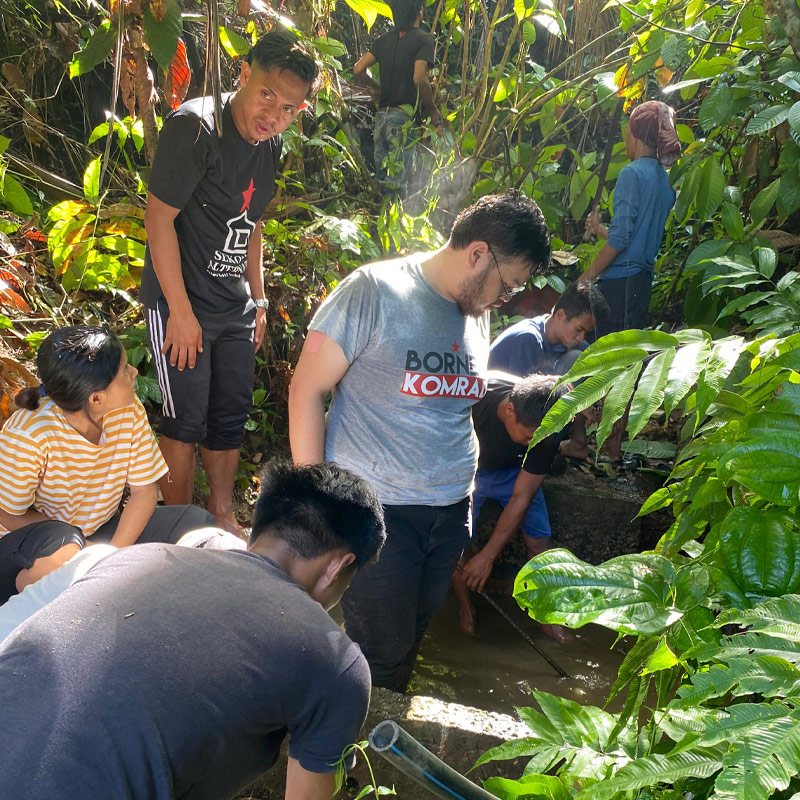
That realisation deepened during a trip into the forest to look for materials, I became acutely aware that the process does not begin at the weaving itself but it starts much earlier, in the forest. Knowing which trees to look for, how to tell them apart, and when they can be taken is part of the knowledge. Without this, the object cannot exist. What is often called “traditional knowledge” is therefore not only about skills, but about long-term relationships with land and materials. These things are not something that can be learned quickly but they are developed through repeated movement, observation, and familiarity over time.
In the kampung, this kind of knowledge is usually passed across generations. Children observe youths, youths learn from adults and adults still rely on elders and learning happens while walking together, working together, or simply being present. It is not organised as a lesson, but it is continuous.
However, today, this continuity is becoming fragile. Many young people now spend long periods away from the kampung, attending formal schools or vocational training elsewhere. At the same time, some youths show less interest in learning practices such as weaving or foraging. This is not because the knowledge is unimportant, but because their time, attention, and aspirations are increasingly shaped outside the kampung. As a result, fewer moments exist where knowledge can be passed on in everyday ways.
This raises questions about how knowledge is preserved. Many conservation and environmental efforts focus on documenting Indigenous knowledge, recording techniques, writing reports and producing manuals. Documentation can be useful. But it captures only fragments of what is being lost. Lived knowledge depends on land access, daily practice, and people being present across generations. When these conditions weaken, written records cannot fill the gap. What is at risk, then, is not only specific skills like weaving or material selection, but a way of learning that is rooted in the body and in place. Without the space and time to live these practices, knowledge becomes something remembered rather than something lived.
Conserving Indigenous knowledge, in this sense, cannot be separated from supporting Indigenous ways of life. If people are unable to remain on their land, move through forests, or spend time learning from one another, knowledge will continue to fade, even if it is carefully documented. What the body learns, paper cannot fully hold.
Thank you, Aisyah binti Badrul Azmi for sharing your experience at COAC!

 Contribute to YELL